Karachi Biryani Is Often Treated as a Recipe
The word “Karachi” is right there in the name, yet it rarely comes up in conversation. People debate restaurants, argue over which version is definitive, recommend their favourite spot in DHA or Burns Road. The city behind all of it stays in the background.
That’s worth noticing.
Biryani has been part of Karachi long enough that the two feel inseparable to most people who grew up there. But the dish didn’t arrive fully formed. It came together inside a city that was itself still being built, shaped by the same waves of migration, displacement, and reinvention that shaped everything else about Karachi. Understanding one helps explain the other.
A city built from different food traditions
Karachi absorbed a lot of people in a short amount of time.
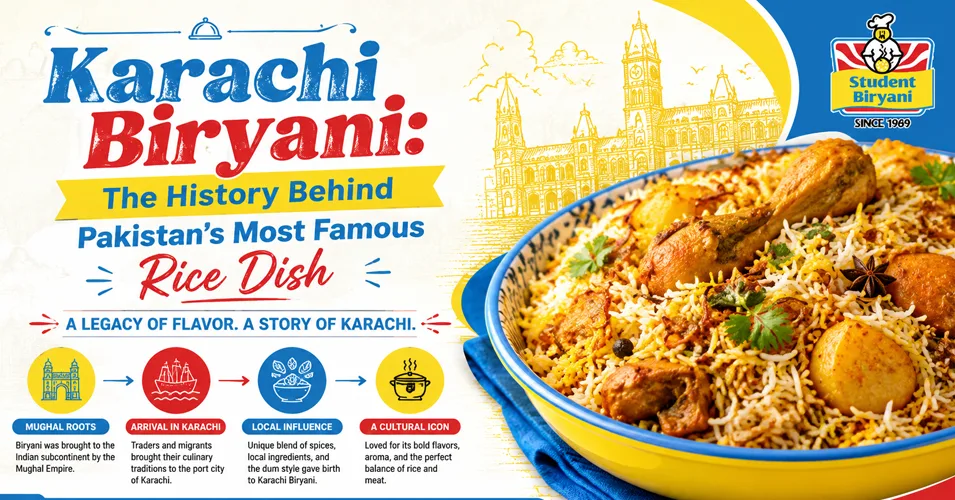
After Partition in 1947, Urdu-speaking Muslim migrants from across India, known as Mohajirs, arrived in significant numbers and settled across the city. They brought cooking traditions from Lucknow, Hyderabad, Delhi, and the broader subcontinent, including their own biryani styles, spice preferences, and ways of eating rice with meat. These weren’t identical to what was already being cooked in Sindh. They mixed with it anyway.
That collision produced something Karachi-specific. The biryani that developed here borrowed from Mughlai technique but landed somewhere different. The masala became heavier, more direct. Whole spices stayed present through the rice rather than quietly disappearing into the gravy. The heat level climbed. It became food built for a city rather than a court.
Neighbourhoods did their own work too. Bohri Bazaar, Burns Road, Tariq Road; these weren’t just locations. They were places where food got tested on real customers, adjusted based on what people actually came back for, and refined through years of competition between stalls and restaurants that were all working within walking distance of each other.
How Karachi Biryani developed its own character
The dish didn’t become famous through a single restaurant or a single cook.
It became famous through repetition across an entire city. Office workers in Saddar ordered it because it was fast, filling, and consistent. Families brought it home on Sundays because it fed many people without fuss. Students found it outside their campuses because the price was right and the portions were honest. The name appeared on handwritten signs, printed menus, and eventually on packaging that travelled out of the city entirely.
Burns Road deserves particular mention. The street developed into one of the most concentrated food corridors in Pakistan, and Karachi Biryani was central to its reputation. Restaurants there competed on the same dish for decades. That kind of sustained competition over one preparation does something to a recipe. It pushes it toward a version that consistently satisfies rather than one that occasionally impresses. The biryani that emerged from that environment was less about refinement and more about dependability.
That’s a different kind of quality, and it’s probably why Karachi Biryani travels the way it does.
Why the dish spread beyond Karachi
There was a time when Karachi Biryani belonged mainly to Karachi.
Today the name is familiar to people who have never lived there. It travels because people do. A favourite meal found in Karachi tends to stay a favourite meal somewhere else. When someone who grew up eating it moves to another city, or another country, they look for it. They talk about it. Sometimes they find it.
Restaurants elsewhere recognized that the name already meant something to certain customers before they placed an order. That kind of familiarity doesn’t require explanation. It just carries the expectation that what arrives will feel like something recognized.
The city stayed attached to the dish long after the dish had travelled far from it.
The story of Karachi Biryani is also the story of Karachi
Most people encounter the food long before they encounter anything about its background.
Viewed only as a recipe, Karachi Biryani is another famous rice dish. Looked at through the history of the city, it becomes something else. It shows how a place absorbs different food traditions over time and how those traditions stop feeling separate and start feeling like they simply belong there.
The name keeps pointing back to the city. Long after the meal is finished, Karachi stays part of the story.