What Are the Main Pakistani Desserts? Beyond Gulab Jamun
Gulab Jamun has a recognition advantage that most Pakistani desserts don’t. It appears on menus across every South Asian restaurant in the UAE, gets ordered by people who know nothing else about Pakistani sweets, and has become the default answer to “what should I have for dessert” in a way that leaves almost everything else in the cuisine undiscovered.
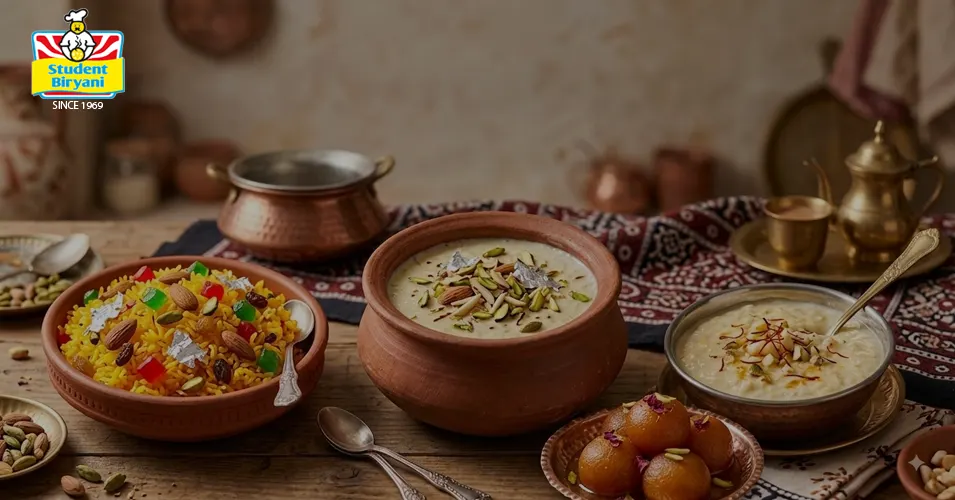
Zarda, Kheer, and Rabri are three traditional Pakistani desserts that appear at weddings, Eid celebrations, and Ramadan gatherings. Each is made through a different method and produces a different texture, sweetness level, and occasion association. None of them are obscure within Pakistani food culture. At a Pakistani wedding in Dubai or Abu Dhabi, all three are more likely to appear on the dessert table than Gulab Jamun is. They simply haven’t had the same introduction to people encountering Pakistani food for the first time.
This is that introduction. What Rabri actually is and how it gets made has its own dedicated piece for readers who want the full picture on that one specifically. Here, the goal is understanding what separates all three from each other and from the assumptions most people bring to Pakistani desserts.
What Is Zarda and Why Does It Appear at Pakistani Weddings?
Zarda is a Pakistani dessert made from cooked rice sweetened with sugar syrup and flavored with saffron, cardamom, and rose water. It is typically garnished with almonds, pistachios, and raisins, and served warm at weddings and Eid celebrations. The name comes from the Persian word for yellow, which describes the dish accurately — the saffron or food coloring that gives Zarda its color is as much a visual signal as a flavor one.
The base is rice, not milk, which immediately sets Zarda apart from Kheer and Rabri. The rice is cooked separately, then finished in a sugar syrup with the aromatics and fat worked through it. The result is individual grains that are sweet, slightly sticky, fragrant with cardamom and rose water, and warm enough to release the saffron aroma properly when served. The garnishes aren’t decorative — the nuts add texture that the rice alone doesn’t have, and the raisins introduce a small burst of concentrated sweetness that works against the more uniform sweetness of the rice itself.
Zarda appears at formal occasions rather than everyday tables for the same reason certain other dishes do: the preparation takes time, the ingredients cost more than a simple milk-based dessert, and the presence of something that clearly required effort signals the host’s investment in the occasion. Why certain Pakistani desserts signal occasion register at Pakistani wedding events is covered in more depth elsewhere, but Zarda’s role is consistent across regions and contexts — it is the dessert that marks a meal as a celebration rather than a regular dinner.
Order Zarda across Student Biryani’s branches if the occasion warrants something that closes a meal in that register.
What Is Pakistani Kheer and How Is It Different From Rice Pudding?
Pakistani Kheer is a dessert made by simmering rice in full-fat milk until the rice softens and the milk thickens slightly. It is flavored with cardamom, rose water, and sugar, and served chilled or warm depending on the occasion and the household. The consistency is pourable rather than set — thicker than plain milk, lighter than a pudding, somewhere between a thin porridge and a sweetened cream with rice distributed through it.
The comparison to Western rice pudding comes up often enough that it’s worth addressing directly. The structure is similar: rice cooked in milk until soft. What differs is almost everything else. Western rice pudding typically uses vanilla, sometimes cream, and produces a starchier, heavier result because the ratio of rice to milk is higher and the cooking time is shorter. Pakistani Kheer uses full-fat milk simmered long enough that some moisture reduces, concentrating the milk slightly before the rice is even fully soft. Cardamom and rose water replace vanilla entirely, which shifts the aromatic register from warm and sweet to floral and slightly cool. The result tastes like a different category of dessert rather than a local variation of the same one.
Kheer is the most versatile of the three desserts in this article. It appears at Eid tables and Ramadan Iftar spreads and also as a regular household dessert after Friday lunch in a way that Zarda doesn’t — the preparation is simpler, the ingredients are everyday, and it scales down to a single portion without losing its character. A household making Zarda is making it for a gathering. A household making Kheer might be making it for two people on a Tuesday. That range of contexts is part of what makes Kheer the most immediately accessible of the three for someone trying Pakistani desserts for the first time.
How Rabri’s density compares to Kheer’s lighter consistency covers the structural distinction between the two milk-based desserts. Order Kheer at Student Biryani across Dubai, Abu Dhabi, Sharjah, and Ajman — it is typically served chilled and holds well if ordered for delivery.
What Is Rabri and How Does It Differ From Kheer?
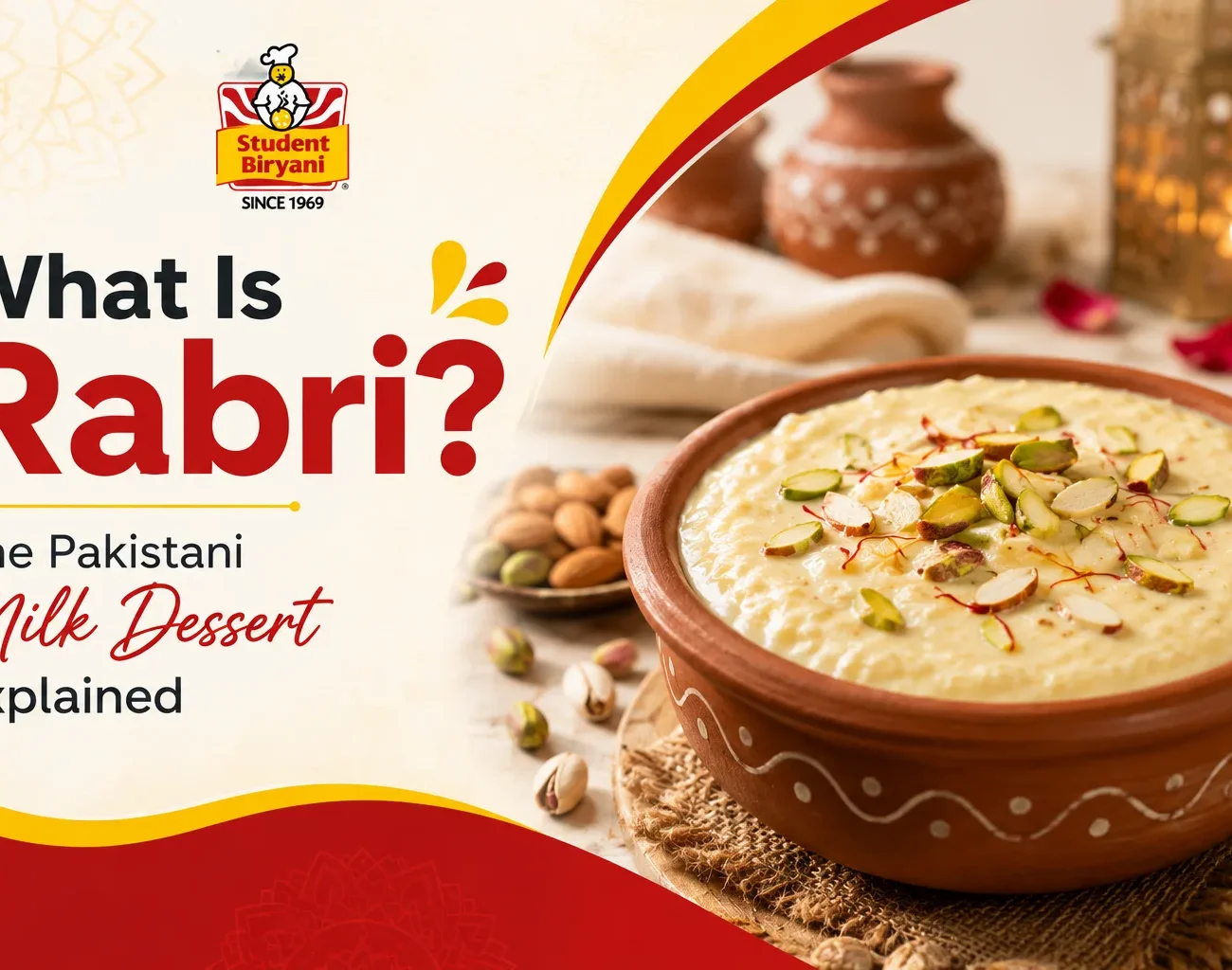
Rabri is a Pakistani dessert made by reducing full-fat milk over several hours until it becomes a dense, layered cream. Unlike Kheer, which is thickened by adding rice, Rabri gets its density from the milk itself through slow reduction, making it significantly more concentrated and intense per serving. The difference in approach produces the difference in outcome: Kheer thickens from the outside in through starch, Rabri concentrates from the inside out through moisture removal.
That structural distinction matters to the eating experience in ways that aren’t immediately obvious from a menu description. A bowl of Kheer is a full-sized dessert portion. A serving of Rabri is smaller because the concentration makes each spoonful more intense than its volume suggests. The layered surface that properly made Rabri shows when it arrives is a visual record of the cooking process — each layer represents a cycle of skin forming on the milk’s surface and being folded back in during reduction. The sweetness reads as coming from inside the density rather than coating it, because the sugar was added during reduction rather than after.
Rabri is most commonly paired with Jalebi in Pakistani cuisine, where the combination works through contrast: Jalebi’s hot, fried, syrupy sweetness against Rabri’s cool, dense, concentrated milk. It also appears at weddings and formal occasions in its own right, where the preparation time it demands signals something about what went into the event. The full explanation of how Rabri is made and what distinguishes it from other Pakistani sweets covers the reduction process, the layering, the Jalebi pairing, and where to find properly made Rabri in the UAE. Order Rabri at Student Biryani for the version made through the full reduction process rather than a shortcut.
Where to Order Zarda, Kheer, and Rabri Across the UAE
Zarda, Kheer, and Rabri are all available at Student Biryani branches across Dubai, Abu Dhabi, Sharjah, and Ajman. Each behaves slightly differently at the ordering stage, which is worth knowing before the decision gets made.
Zarda is served warm and is best eaten close to when it arrives. The saffron aroma is most present when the dish is at temperature, and the sugar syrup that runs through the rice tightens slightly as it cools. It is the least delivery-friendly of the three — not because it degrades badly, but because the warm-serving context is part of what makes it work. At a restaurant table it lands in its best form.
Kheer travels better. The chilled version that most UAE Pakistani restaurants serve is already at a stable temperature, holds its consistency in a sealed container, and arrives representing what it is. Which Pakistani dishes and desserts hold best during delivery covers the full picture of delivery behavior across the menu. For Kheer specifically, the answer is straightforward: order it and it arrives well.
Rabri’s density makes it the most structurally stable of the three in transit. The concentration that produces its texture also insulates it against the temperature drop that affects lighter desserts during delivery. The layered surface may compact slightly in the container, but the eating quality holds in a way that a thinner dessert wouldn’t. All three deserve more recognition than Gulab Jamun’s shadow currently allows them. The search volume is there. The curiosity is there. The desserts themselves have been waiting for an introduction that takes them seriously.