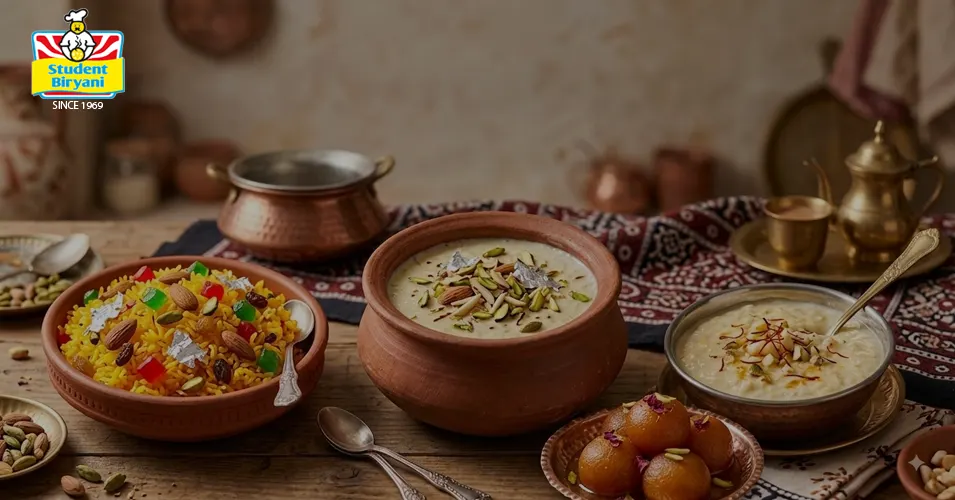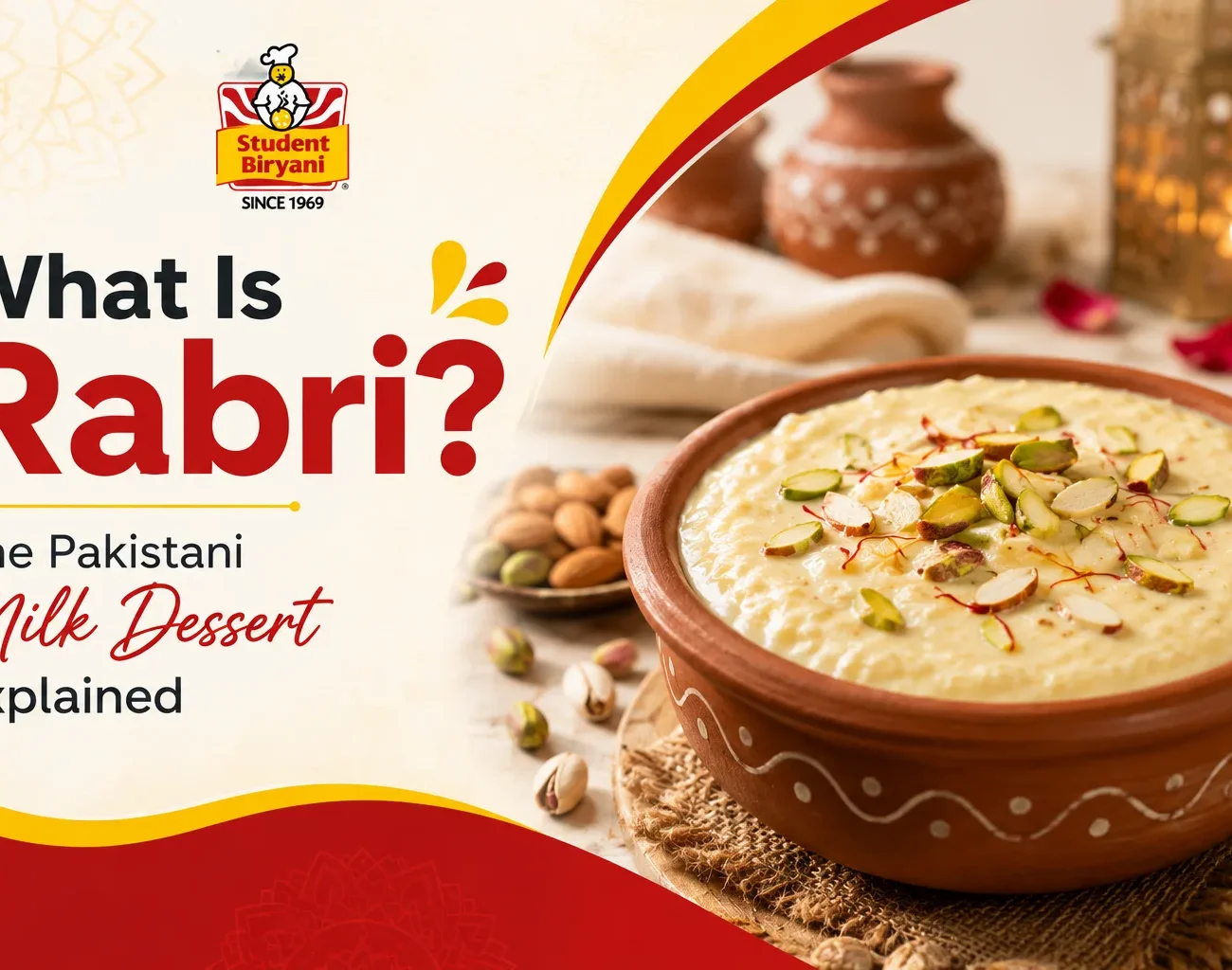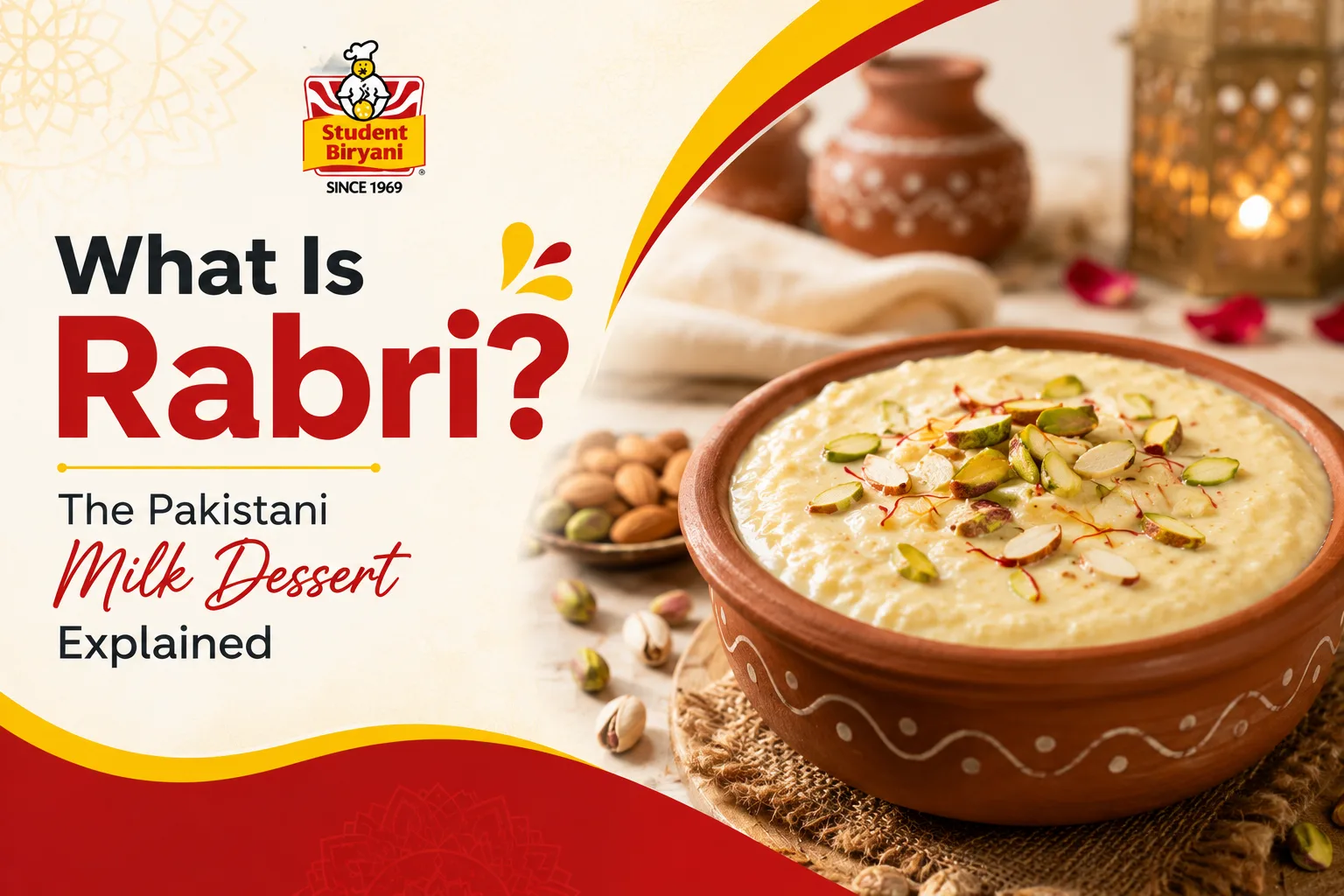
Rabri is a Pakistani dessert made by slowly reducing full-fat milk over low heat. As the milk reduces, it thickens into dense, layered cream with a concentrated, lightly caramelized sweetness. It is neither a conventional pudding nor a custard. Although both desserts are milk-based, Rabri is also different from Kheer. The process defines the dessert. Understanding how Rabri is made is the quickest way to understand what makes it unique.
Rabri appears on Pakistani restaurant menus across the UAE often enough to generate significant search interest. Many people encounter the name for the first time and look it up before deciding whether to order it. Most of those searches lead to incomplete or generic explanations. Rabri belongs to a group of traditional Pakistani desserts that are familiar to people who grew up eating them but remain unfamiliar to many others, including much of the South Asian community in the UAE, whose experience often extends only to desserts like Gulab Jamun and Kheer.
If you’re wondering how Rabri compares to Zarda and Kheer across the Pakistani dessert register, that’s a conversation worth having on its own. First, though, it helps to understand the dessert itself, how it’s made, and why the cooking process defines the final result.
How Rabri Is Made: The Milk Reduction Process
Full-fat milk goes into a wide, heavy pan over low heat and stays there for two to three hours. Traditional Rabri takes that long because the milk must reduce slowly over low heat. Rushing the process produces a thinner dessert with less depth, fewer layers, and a weaker flavor. Time is what gives Rabri its distinctive texture and richness.
As the milk heats, a skin forms on the surface. In most other cooking contexts, that skin gets skimmed off and discarded. In Rabri, it gets pushed to the edge of the pan and folded back in. The same process repeats throughout the cooking time. A new layer forms, is gently pushed to the edge of the pan, and folded back into the milk before the next layer begins to develop. The layers that define Rabri’s texture are the result of repeated folding during the reduction process. Each layer represents another cycle of milk skin forming and folding back into the dessert. As the cooking continues, the layers become more pronounced.
Sugar is added during the reduction process instead of at the end. As the milk concentrates, the sweetness develops with it, creating a flavor that feels naturally integrated instead of simply added afterwards.
The same principle explained in Why slow cooking produces results that faster methods cannot replicate is just as relevant to Rabri as it is to Nihari or Haleem. The cooking method may differ, but the underlying idea remains the same. Time under steady heat creates a structure that no shortcut can reproduce. A Rabri prepared in thirty minutes is fundamentally different from one slowly reduced over two and a half hours, and you can see the difference before the first spoonful.
How Rabri Differs From Kheer and Other Pakistani Milk Desserts
Rabri is denser and more concentrated than Kheer because it contains no added starch. Its thick texture comes entirely from milk solids created during slow reduction. That single distinction produces two very different eating experiences despite both desserts starting from the same base ingredient.
Kheer is milk with rice. The rice absorbs liquid during cooking and releases starch into the milk, which thickens it gradually. The result is a pourable, relatively light consistency where individual grains of rice are distributed through a sweetened milk base. A bowl of Kheer is a full portion. It has volume without the intensity that comes from pure concentration.
Rabri has no rice, no grain, no starch addition of any kind. The thickening comes entirely from moisture leaving the milk over hours of reduction. The milk solids that remain are concentrated into a small volume of very dense cream. A serving of Rabri is smaller than a serving of Kheer not because of portioning convention but because the intensity per spoonful is significantly higher. It is not a dish that works in large quantities precisely because it was built by removing most of the liquid that would have made that possible.
Firni is a traditional Pakistani rice dessert made with finely ground rice and milk. It sits between Kheer and Rabri in both texture and consistency. Because the rice is finely ground, Firni becomes smoother than Kheer while remaining lighter than Rabri. It is traditionally served chilled in clay dishes, which helps preserve its cool, delicate texture.
Comparing Rabri with Kheer explains only part of the story. How Rabri, Zarda, and Kheer each close a Pakistani meal differently explores how each dessert contributes to the end of a traditional Pakistani meal and why they continue to coexist on the same menu.
When and How Rabri Is Served in Pakistani Food Culture
Rabri is traditionally served with Jalebi in Pakistani cuisine because the cool, creamy dessert balances the hot, crisp sweetness of freshly made Jalebi. Jalebi is hot, fried, syrupy, aggressively sweet, and slightly crisp from the frying. Rabri is cool, dense, restrained in its sweetness despite the concentration, and soft throughout. Together, they create a balance of textures and flavors that neither dessert achieves on its own. The Jalebi’s syrup loosens against the Rabri’s density. The Rabri’s coolness cuts through the Jalebi’s heat. It’s one of the most carefully balanced dessert pairings in Pakistani cuisine, with each element enhancing the other.
Rabri often appears at Pakistani weddings and formal gatherings as part of the dessert table. Its presence reflects the time and effort required to prepare it, something lighter desserts don’t communicate in the same way. Because properly made Rabri takes hours, its appearance at a gathering says something about what went into the occasion.
To better understand why desserts carry so much significance at the end of a traditional celebration, How desserts function as closing signals at Pakistani wedding events explores the customs and expectations that shape that final course.
During Ramadan, Rabri appears at both Iftar and Sehri. The richness that makes Rabri an occasional dessert suits Ramadan particularly well. After a day of fasting, Iftar calls for something substantial and satisfying. Before a long day without food, Rabri also works well at Sehri because its concentrated texture makes a small serving feel nourishing alongside bread and savory dishes. The same richness that makes Rabri too substantial for an everyday meal is exactly what makes it suitable for both Iftar and Sehri.
In the UAE, Rabri is most often served chilled or at room temperature. The chilled version becomes slightly firmer than the warm version commonly served in Pakistan. The flavor stays the same, but the texture feels noticeably different. The layers become more pronounced when chilled. The sweetness feels slightly more restrained. If you’re trying Rabri for the first time in the UAE, you’re more likely to be served the chilled version than the warm one commonly found in Pakistan. Knowing that beforehand helps set the right expectation.
Where to Order Rabri in the UAE
Rabri is available on Pakistani restaurant menus across Dubai, Abu Dhabi, Sharjah, and Ajman. The real difference lies in how it’s prepared. Traditional Rabri is made through slow milk reduction, while some versions rely on a thickened milk base that produces a very different dessert.
Properly made Rabri has a visible layered surface when it arrives. The layers aren’t decorative. They are the visible result of the repeated folding process described earlier. A Rabri without visible layering was likely not made through the traditional reduction method. The sweetness should feel naturally integrated into the dessert instead of sitting on the surface as a separate sugary layer. The texture should hold its shape when disturbed instead of flowing immediately like a thin cream.
It resembles a sweet cream instead of a dessert developed through hours of careful reduction. It eats like a sweet cream rather than like something that took two hours to become what it is.
Student Biryani prepares traditional Rabri using the slow milk reduction method at its branches in Dubai, Abu Dhabi, Sharjah, and Ajman. You can Order Rabri from your nearest Student Biryani branch or for delivery. Its naturally dense texture travels exceptionally well, helping it retain its consistency better than many lighter milk-based desserts. If you’d like to explore the wider Pakistani dessert tradition, How Rabri sits alongside Zarda and Kheer in the Pakistani dessert register explains how each dessert serves a different role while sharing the same culinary heritage.
Rabri generates more searches than almost any other Pakistani dessert on this site. The dessert behind those searches is distinctive and unlike what many people expect when they first encounter the name.Understanding what Rabri is, how it’s made, and why it has earned such a respected place in Pakistani cuisine makes that first encounter much more rewarding.