What Is Tandoor Naan and What Makes It Different From Regular Naan?
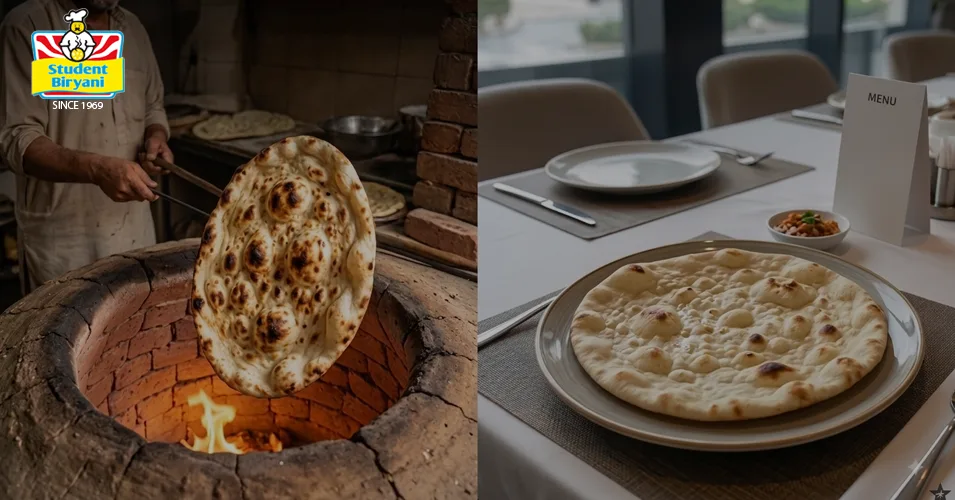
Tandoor naan is a Pakistani flatbread cooked by pressing raw dough directly onto the inner wall of a clay tandoor oven, where temperatures exceed 400 degrees Celsius. The intense heat and direct clay contact produce a crust, char, and internal texture that conventional ovens and flat griddles cannot replicate. The dough itself is not what makes tandoor naan distinct. The environment that cooked it is.
Most naan served across UAE restaurants, hotel buffets, and South Asian establishments was made in a conventional oven or on a flat griddle. The bread that comes out of those methods is soft throughout, uniformly pale, and behaves the same way from the first bite to the last. It is not bad bread. It is simply a different product from what a clay tandoor produces, and the difference is significant enough that calling both things naan without qualification creates a misleading equivalence.
Why the bread that accompanies Pakistani dishes matters as much as the dish itself is something the bread pairings piece covers in depth. The starting point here is understanding what tandoor naan actually is before reaching for the bread basket.
What Is a Tandoor Oven and Why Does It Matter for Pakistani Bread?
A tandoor is a cylindrical clay oven used in Pakistani and South Asian cooking that reaches temperatures between 400 and 500 degrees Celsius. Bread dough is pressed directly onto the inner clay wall, where it cooks through a combination of radiant heat from the clay, convective heat from the fire below, and direct contact with the hot surface. Those three heat sources act simultaneously on the dough for sixty to ninety seconds, which is the entirety of the cooking time.
The clay construction is not incidental to the result. Clay retains heat differently from metal. It absorbs heat slowly during the firing process and then radiates it steadily and intensely from every point of its surface. When dough makes contact with a clay wall at 450 degrees, the outer surface of the dough sets almost immediately while the interior is still raw. That rapid surface-setting is what creates the crust. The steam that builds inside the dough during those first seconds, unable to escape through the already-set outer surface, is what creates the layered internal structure that tears apart when pulled.
A conventional oven circulates hot air around the bread. The heat reaches the dough from every direction at once, which means the outside and inside cook at similar rates. The result is bread that is consistent throughout, which is a different goal from what a tandoor is trying to produce. How the speed of cooking in a tandoor contrasts with the slow heat that produces Pakistani curry depth illustrates how Pakistani cooking uses extreme opposite ends of the heat spectrum for different results. A tandoor naan takes ninety seconds. A proper Nihari takes all night. Both are right for what they are.
How Tandoor Heat Creates the Crust, Char, and Texture Pakistani Naan Is Known For
The char spots on tandoor naan are produced by direct contact between the dough and the hottest points on the clay wall. They are not a sign that something went wrong. They are the surface record of where the dough touched clay at maximum temperature, and the Maillard reaction that produces them also produces the flavor compounds that give the crust its particular taste. A tandoor naan without char spots was either cooked at insufficient temperature or didn’t maintain contact with the clay wall long enough to develop them properly.
The side of the naan that faced the clay wall and the side that faced the fire behave differently because they experienced different heat sources. The clay-contact side develops the crust and the char. The fire-facing side gets the convective heat that finishes the interior without drying it out. Pull a piece of properly made tandoor naan apart and the internal structure shows the result of that process: layers created by steam expanding through the dough before the outer surface set completely, with a slight chewiness that comes from gluten developed during the brief, intense cook rather than a long, slow one.
Butter gets brushed onto naan in many establishments, and the practice is worth understanding for what it reveals. On properly made tandoor naan, butter adds a flavor layer but the bread doesn’t need it to taste complete. The Maillard compounds on the crust, the slight char, and the internal structure already produce a bread with its own flavor. When butter is compensating for something rather than adding to something, it’s usually compensating for bread that came out of a conventional oven without the char and crust development that gives tandoor naan its character.
How the bread alongside Pakistani breakfast dishes changes the experience of the meal is something the Halwa Puri article addresses directly. The principle is the same here: the structural properties of the bread are functional, not decorative.
What Are the Different Types of Pakistani Naan?
Pakistani naan varieties are defined by what gets added to the base dough or pressed onto its surface before it goes into the tandoor. The cooking method is the same across all of them. What changes is the flavor layer introduced through the filling or topping.
Plain tandoor naan is the base. Nothing is added beyond the dough, water, and the leavening that gives it lift. The char, crust, and internal texture are the only variables, and they are determined entirely by the tandoor and the skill of the baker. This is the version that pairs with karahi, Nihari, and curry dishes where the bread’s job is structural rather than flavoring.
Garlic naan has minced garlic pressed into the surface of the dough before it goes into the tandoor. The garlic chars slightly alongside the bread during the firing, which mellows its sharpness and produces a roasted quality rather than a raw one. It is the most ordered variation across Pakistani restaurants in the UAE and works alongside most of the same dishes as plain naan.
Keema naan is stuffed with spiced minced meat before the dough is sealed and pressed onto the clay wall. The filling steams inside the sealed dough during the tandoor cook, which means the meat is cooked entirely by the steam it generates within the pocket rather than by direct heat. Keema naan functions as a complete meal on its own rather than as an accompaniment and is typically heavier than the other varieties as a result.
Roghni naan is glazed with an egg wash and scattered with sesame seeds before the tandoor. The egg wash produces a shinier, slightly richer surface and a softer crust than plain naan develops. It is common at formal occasions and wedding spreads where the visual quality of the bread is part of what the table is communicating.
Peshwari naan, less common across UAE Pakistani restaurants but present on some menus, is filled with a sweetened mixture of nuts and coconut. It sits closer to a dessert bread than an accompaniment and belongs to a different eating context from the savory varieties.
All five are produced through the same tandoor method. Which naan variety pairs best with Nihari and other slow-cooked Pakistani dishes covers the matching logic in practical detail.
What to Eat Pakistani Tandoor Naan With and Where to Order It in the UAE
Pakistani tandoor naan is traditionally served alongside karahi, Nihari, and curry dishes where the crust provides structural support for thick, sauce-heavy preparations. Student Biryani serves tandoor naan across branches in Dubai, Abu Dhabi, Sharjah, and Ajman [Branch reference: /our-branches/ (activate now)]. The pairing logic is functional rather than conventional: a sauce with Nihari’s coating weight or karahi’s reduced masala needs bread that holds its structure through repeated dipping rather than softening immediately on contact.
Plain and garlic naan handle that role. The crust that came out of the tandoor holds up through the first piece, the second, and the third without losing the structural quality that makes it useful alongside heavy sauces. Softer bread softens further on contact with a thick masala. Tandoor naan maintains enough resistance that each piece carries sauce to the mouth cleanly rather than folding under it.
Keema naan sits outside that pairing logic. It doesn’t need an accompanying dish because the filling already provides what the meal requires. Ordering it alongside a heavy karahi produces more food than the meal needs rather than a complementary combination. It is the variety worth ordering when the meal is the bread itself.
Why Nihari specifically demands bread rather than rice as its companion goes into the sauce-structure relationship that makes this pairing work. For anyone ordering Nihari at Student Biryani, ordering tandoor naan rather than accepting whatever bread arrives automatically changes what the meal produces. How Halwa Puri uses a different bread format to achieve the same structural function covers the breakfast parallel where a different bread does the same job against a different dish. Most people in the UAE have eaten naan. The version served across most menus is acceptable bread. Tandoor naan from a clay oven at proper temperature is a different product with a different character, and the difference is not subtle once the two have been compared side by side.