Herbs Are Not Spices With Leaves
The grouping happens automatically. Menus list them together. Recipes treat them as the same category of ingredient. Most food writing about Pakistani cooking moves between coriander and cardamom without marking any distinction between what each one is doing or why.
The distinction matters because herbs and spices work through completely different mechanisms, and those mechanisms respond to heat in opposite ways.
Spices release their character through heat and fat over time. A clove in hot oil gives up its aromatic compounds gradually. Cumin in a masala builds across the cooking period rather than peaking and collapsing. How spices release their character through heat and fat during Pakistani cooking is a separate conversation, but the key point here is directional: spices generally need heat to do their work.
Herbs generally don’t. The volatile compounds that carry an herb’s contribution are often destroyed by sustained heat rather than activated by it. Fresh coriander cooked into a masala from the beginning tastes nothing like fresh coriander added after the flame goes off, not because the quantity changed but because the compounds that make fresh coriander useful are gone by the time the masala is done.
Timing defines what an herb contributes more than the herb itself does. The same plant at different stages of the same cooking process is performing different functions. Understanding that changes how a dish gets read, both in the kitchen and on the plate.
Fresh Coriander: The Herb That Works After the Heat
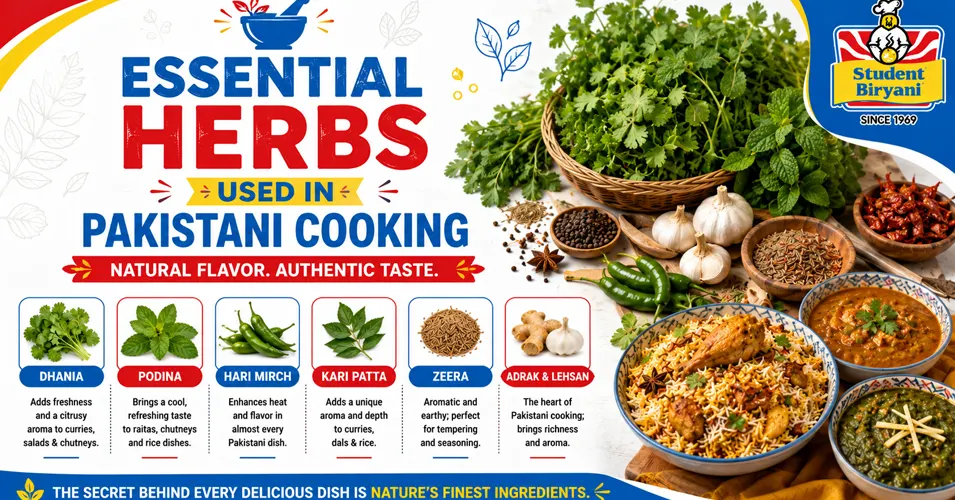
Fresh coriander appears on top of more Pakistani dishes than any other herb, and the placement is functional rather than decorative.
The volatile compounds in fresh coriander, the ones that carry its brightness and its particular sharp-green quality, degrade rapidly under sustained heat. Cooking fresh coriander from the beginning of a masala doesn’t intensify it. It collapses it into something barely present, a faint background note that adds nothing the dried version wouldn’t have covered more efficiently.
Added after the heat, those compounds remain intact. Against a fat-rich finished dish, specifically something like karahi where the sauce has been reducing under direct heat and the oil has separated to the surface, fresh coriander does something no cooked ingredient can do at that stage. It cuts. The bright volatile compounds lift the top register of the dish, introduce a freshness that the cooking process spent twenty minutes removing, and change what the first bite tastes like without changing the masala underneath.
Dried coriander seed is a different ingredient entirely, functioning as a spice in the middle of cooking, contributing warmth and earthiness through heat and fat. The two forms of the same plant have almost nothing in common in terms of function. Grouping them as “coriander” in a recipe without marking that distinction produces two very different dishes depending on which one goes in and when.
Fresh coriander on a finished dish is not the cook finishing the plate. It is the last functional decision in the recipe.
Dried Fenugreek and Mint: Two Herbs, Two Stages, Two Functions
Kasuri methi and fresh mint sit at opposite ends of the cooking process and perform functions so different that grouping them as herbs in the same sentence risks making them seem more similar than they are.
Kasuri methi, dried fenugreek leaves, goes into the masala during cooking rather than after it. Heat and fat activate a slightly bitter, aromatic quality in the dried leaves that fresh fenugreek doesn’t produce in the same way, and that dried form doesn’t produce at room temperature. The drying process changes the compound profile of the plant, and heat changes it further. The result is an aroma that reads as depth underneath the masala rather than brightness above it, the opposite of what fresh coriander does, and it only develops because it went in during cooking rather than after.
Fresh mint behaves in the opposite direction entirely. Its volatile compounds are highly sensitive to heat, more so than fresh coriander’s, and drying mint collapses most of what makes it useful before cooking even begins. Dried mint is a different and considerably diminished ingredient. Fresh mint belongs in cold or room-temperature applications specifically because its cooling compounds need to arrive at the palate intact. In raita, alongside grilled items, scattered over a finished plate, mint is performing a palate-resetting function rather than adding flavor in the conventional sense. How raita performs a palate function rather than a flavor one covers that mechanism directly. The mint in raita and the mint on a plate of seekh kabab are doing the same job: interrupting richness so the next bite lands as clearly as the first.
Two herbs. One needs heat to work. One needs heat to stay away from it.
Curry Leaves and Green Chilies: Herbs That Change the Cooking Medium
Tarka is the technique of adding ingredients to hot oil or ghee before the main cooking begins, and both curry leaves and green chilies function specifically inside that technique rather than at any other stage.
Curry leaves go into the hot oil first, and what happens in the first thirty seconds is the entirety of their functional contribution. The leaves release aromatic compounds into the oil rapidly on contact with heat, and those compounds dissolve into the fat and travel into everything cooked in that oil afterward. The leaves themselves are rarely eaten. By the time the dish is finished, they have already done their work. A curry leaf sitting in a finished dish is not contributing flavor at that point. It contributed it at the beginning, to the medium rather than the dish directly. How whole spices release into oil during Pakistani cooking explains the broader mechanism behind this. Curry leaves follow the same principle but release faster and more completely than most whole spices do.
Green chilies in tarka work through a different mechanism. Fresh chilies contain water, and when that water contacts very hot fat it creates a brief, intense interaction that transfers both heat and a specific vegetal compound into the oil in a way that dried chili powder cannot replicate. Dried chili adds heat and color. Fresh chili in hot oil adds heat, a green sharpness, and a compound profile that comes from the water-fat interaction itself. Remove the fresh chili and substitute dried, and the dish has the same heat level on paper and a different character entirely in the bowl.
Both herbs finished their work before the main ingredients arrived. The dish they changed was the oil, not themselves.
Reading a Dish Through Its Herbs
Once the functional logic is clear, the herbs on a plate start communicating something specific about how the dish was cooked.
Fresh coriander on top signals a post-heat addition, a cook who knew the volatile compounds needed to arrive intact and made a deliberate timing decision. Kasuri methi worked into the masala signals slower aromatic development that required heat and fat to activate, something that went in during cooking to build depth rather than add brightness. Mint alongside a dish signals a cooling counterpart rather than a flavor component, placed specifically to reset the palate between bites of something richer. Curry leaves visible in the base of a tarka signal that the oil was changed before anything else went in, that the cooking environment was altered from the first minute.
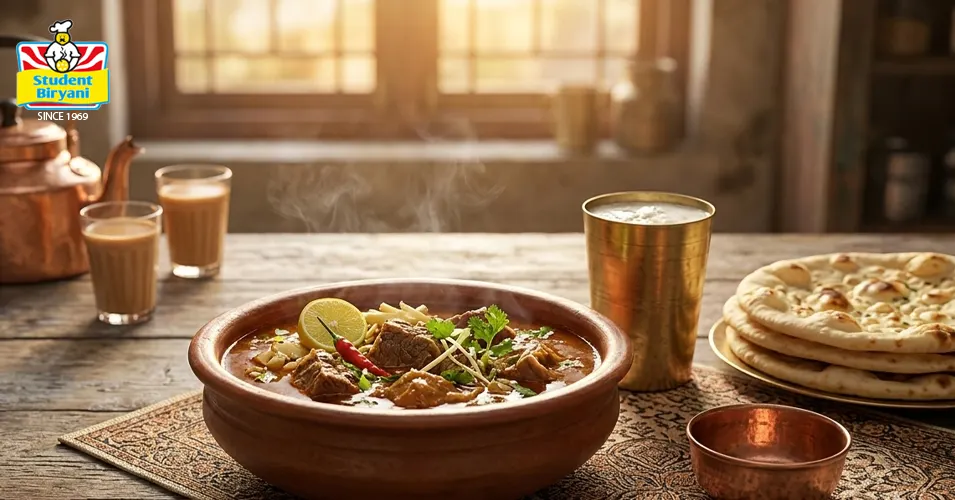
Why karahi’s cooking process makes herb function more visible than in most other Pakistani dishes comes down to the open vessel, the high heat, and the absence of a lid to contain what the herbs release. Fresh coriander on a finished karahi is doing more visible work than on a gentler dish because the fat separation and reduction that karahi produces gives the herb’s compounds something stark to cut against. Student Biryani’s karahi is where that herb function lands most clearly on the plate.
Order karahi across Dubai, Abu Dhabi, Sharjah, and Ajman branches and the herbs on the finished dish are worth reading before eating.
Decoration and function look identical from above the plate. The difference is in understanding what was decided before the dish arrived.