They Look Similar on the Menu. They Don’t Cook the Same Way.
Most Pakistani restaurant menus group them together. Karahi, Handi, Korma sitting in the same section, described in similar language, priced within range of each other. That grouping creates a natural assumption: these are variations of the same thing.
They are not.
The differences between these three dishes don’t come from spice level or personal preference. They come from the kitchen. Each one follows a different cooking logic, a different relationship between heat, vessel, fat, and time. What ends up on the plate looks comparable. How it got there is a separate story entirely.
Karahi is built around reduction and direct contact. Handi works by sealing everything in. Korma relies on fat to do what heat alone cannot. Three mechanisms. Three outcomes that happen to share a serving plate and a menu category.
Understanding that separation changes how you order. It also changes what you taste, because you stop comparing dishes that were never trying to do the same thing.
Karahi: Heat, Reduction, and Direct Contact
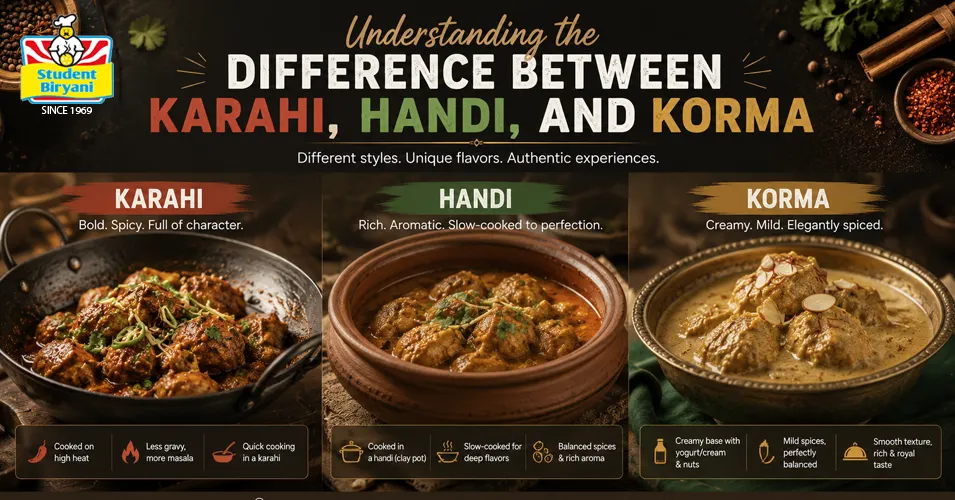
The pan itself is part of the cooking. A karahi is a rounded, wok-shaped vessel with sloped sides and a wide open surface. That shape is not incidental. It allows moisture to escape quickly, forces the sauce to reduce rather than accumulate, and keeps the heat concentrated at the base where meat and spices make direct contact.
Nothing is buffered in a karahi. No lid trapping steam, no fat medium slowing the heat down, no liquid base diluting the spice. Tomatoes break down under high heat and become the acid driving the reduction. Oil separates to the surface as moisture leaves. Spices press directly against the meat rather than floating through a sauce.
Flavors don’t develop gradually here. They get forced together under sustained heat, pressed into concentration by a process that removes rather than accumulates. The cooking time is shorter than both handi and korma, and that brevity shows in what lands on the plate.
When people describe karahi as direct or sharp, they’re describing a cooking outcome, not a seasoning choice. The pan did that.
If you want to understand what karahi actually tastes like before ordering, Student Biryani’s karahi menu gives you a practical starting point across chicken, mutton, and a few regional variations.
Handi: What Happens When You Seal the Heat In
A handi vessel is deeper than a karahi and built to be covered. Sealing the pot changes the entire cooking logic, not just the pace of it.
When heat and moisture stay inside, the process stops being about reduction and becomes about accumulation. Steam circulates through the spices, carrying aroma back down into the sauce rather than releasing it into the kitchen. Layered spices don’t hit the meat directly. They reach it gradually, distributed through trapped moisture that keeps cycling through the pot throughout cooking.
Karahi concentrates flavor through removal. Handi develops it through containment. Aroma in a handi dish tends to be more pronounced because it has been building inside a sealed environment rather than escaping during cooking. Sauce and meat integrate more completely because moisture keeps them in contact over a longer period, without the aggressive heat that would otherwise push them apart.
Texture shifts too. Sealed cooking softens meat more evenly than open high-heat methods do. Not better, categorically different. A handi dish that tasted like a karahi would be a failure of technique.
For readers interested in how sealed and slow cooking produces flavor depth that faster methods can’t replicate, the piece on why slow-cooked foods develop richer flavor profiles goes deeper into that mechanism.
Korma: When Fat Does the Work That Heat Cannot
Korma belongs to a different cooking tradition than either of the previous two. Not a different heat level. A different medium entirely.
Karahi and handi both work primarily through water, whether that’s tomato liquid reducing in an open pan or steam trapped inside a sealed vessel. Korma works through fat. Yogurt, cream, or nut paste forms the base, and fat carries spice through food differently than water does. It coats rather than penetrates, distributes evenly rather than concentrating at contact points, and produces a texture in the final sauce that water-based cooking doesn’t reach.
Meat cooked slowly in a fat-based medium breaks down without the pressure that handi applies or the intensity that karahi demands. What comes out is a dish where sauce and meat feel like they belong to the same texture register rather than sitting in contrast with each other.
Mughal court cooking is where this method developed, not because the history changes the flavor, but because it explains why the technique exists at all. Court kitchens had access to expensive fat-based ingredients and the time to cook slowly. A method built around richness and integration rather than concentration or depth came directly out of those conditions.
Calling korma mild misreads what it actually is. Less spice is not what defines it. Every bite carries spice. It just travels through a different mechanism than what karahi or handi use.
Three Dishes, Three Decisions
Each cooking logic points toward a different kind of meal.
Karahi suits a preference for heat that stays present and flavors that stay forward. Nothing gets softened or blended during the reduction process. Spice contact is direct, individual elements remain distinct, and the dish moves quickly from pan to plate. You can taste that speed.
Handi rewards patience. Aroma arrives before the first bite, and by the time the dish reaches the table, flavors have had enough time together that separating them becomes difficult. Sauce doesn’t sit beside the meat. Both have spent long enough in the same sealed environment that they arrive as a single thing.
Korma is the choice when richness is the point. Fat-based cooking produces a coating quality rather than a cutting one, and that changes how the dish sits in the mouth. Calling it the milder option misses what it actually offers. Richness built through emulsification is a different sensation from heat built through reduction.
None of this appears on a menu. Names, proteins, prices. What each dish does in the kitchen, and what that produces on the plate, is treated as assumed knowledge.
Karahi, handi, and korma are three separate cooking decisions sharing a menu section. Ordering any of them with an understanding of what they’re actually doing produces a more deliberate meal than ordering by name alone.