The Dish That Makes No Sense Until It Does
Nihari appears on Pakistani restaurant menus between karahi and korma, listed among the heavier options, and first-time visitors tend to file it alongside the kinds of dishes that belong to long evenings and unhurried dinners. The assumption is reasonable from a menu read. It doesn’t survive contact with how the dish is actually eaten.
Nihari is a breakfast food.
Not historically a breakfast food, now repurposed for dinner. A breakfast food, still eaten that way by millions of people, still found at dawn outside small restaurants where the pot has been going since the previous night and the first customers arrive before the city has properly started.
The timing is the most interesting thing about Nihari, and it almost never gets explained. The dish has a specific reason for existing at the hour it does, a practical reason that has nothing to do with cultural habit for its own sake. Understanding it doesn’t just explain the timing. It changes what the dish actually is.
Why overnight cooking produces a different dish than any other method is part of the story. The rest starts much earlier, in a city that no longer exists in the same form, with people who needed something specific from their morning that most breakfasts couldn’t provide.
Where the Timing Came From
The word Nihari comes from the Arabic Nahar, meaning morning. The dish is named for the time it’s eaten, which is already a clue about how central the timing was to its identity from the beginning.
Old Delhi in the Mughal period produced much of what eventually became foundational to Pakistani food culture, and Nihari was one of those things. The specific origin sits not in royal kitchens but in the areas around them, among laborers and workers doing sustained physical work who needed to eat substantially before a long day and couldn’t afford to eat again until it was over.
The overnight cooking logic followed directly from those conditions. Tougher cuts of meat, the ones available to people who weren’t choosing from the best of the market, went into the pot after the previous day’s work ended. The pot cooked through the night. By Fajr, by first light, the dish was ready. The people who needed it most ate it then, before the day’s work began, and went out sustained in a way that a lighter breakfast couldn’t have managed.
Partition carried that habit into the cities that became Pakistan, Karachi, Lahore, Peshawar. How Partition shaped what Pakistani food became in its new cities is a longer story, but Nihari traveled with the people who had always eaten it and landed in the same position it had always occupied: morning, before the day starts, the pot already done by the time the customer arrives.
The timing wasn’t arbitrary. It was the whole point.
Why the Weight Makes Sense in the Morning
The contradiction resolves itself once you understand what the dish was built to do.
Nihari is heavy because it was designed for people who needed to sustain themselves across a long physical day on a single morning meal. The rendered fat, the gelatin that develops from collagen breaking down through overnight cooking, the protein from cuts that spent hours becoming something different from what they started as, all of that combines into a meal that stays with the body across a working day in a way that lighter food simply doesn’t. What rendered fat and gelatin do to a dish over a long cooking period explains the mechanism. The outcome is a dish that holds in a way that most food, regardless of quantity, doesn’t replicate.
Construction workers in Sharjah, early-shift drivers in Dubai, people running long working days on a single meal break, for these people Nihari at dawn still makes the same practical sense it did in Old Delhi. Not as a romantic cultural continuation, but as the same basic equation: one substantial meal before a long day, from a dish specifically built for that purpose.
The weight that makes Nihari seem like the wrong breakfast choice is exactly what made it the right one. The people who needed it weren’t eating it because it was traditional. They were eating it because nothing else did the same job.
How Nihari Is Actually Eaten in the Morning
The dish arrives differently at seven in the morning than it would at nine at night, partly because of what accompanies it and partly because of the pace at which a morning meal gets eaten.
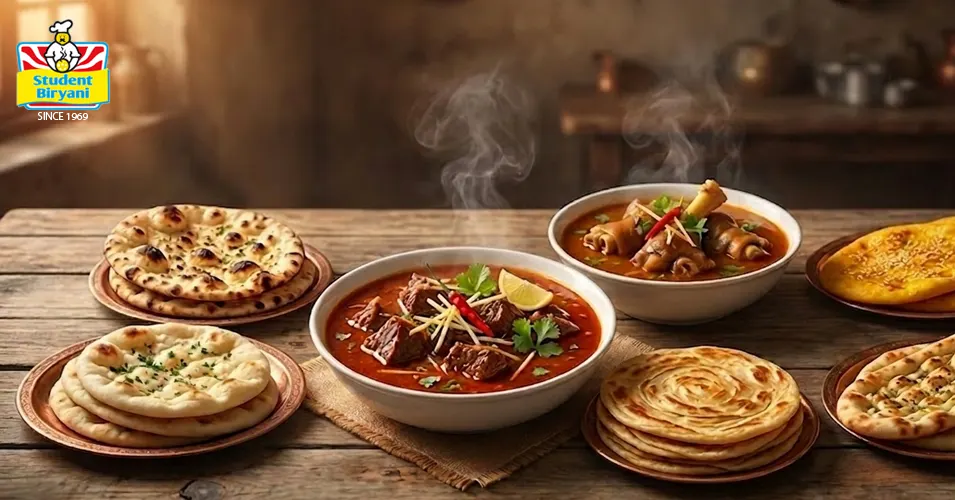
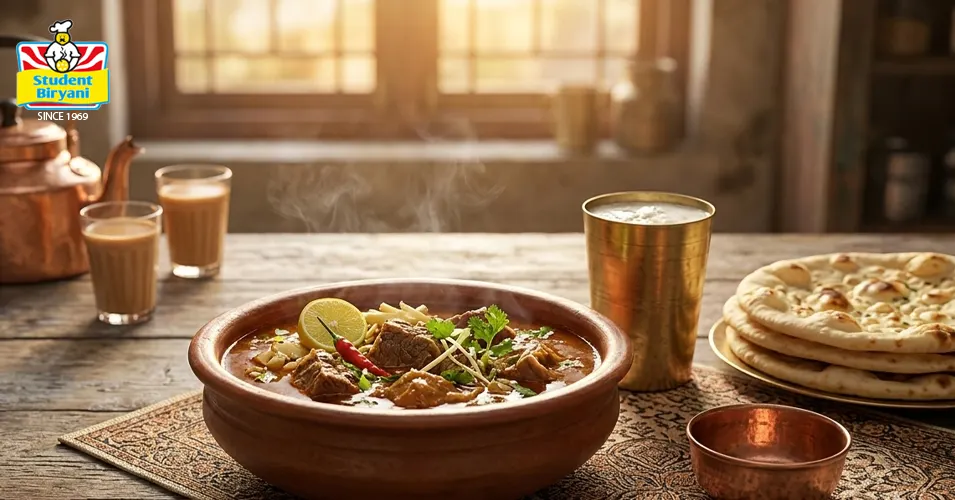
Naan comes with it, not as an option but as the default companion. The sauce in Nihari is too present, too weighted, to eat against rice in the morning. Bread gives it somewhere to go. You tear, you dip, you let the naan carry the sauce rather than pushing it around. Why the bread choice alongside Nihari matters as much as the dish itself goes deeper into that pairing logic, but the morning version is practical rather than considered. The bread is already there, the sauce demands it, and the combination moves at the pace of a meal that has somewhere to be afterward.
The garnishes arrive separately and do specific work. Fresh ginger brings sharpness that cuts through the fat. A squeeze of lemon shifts the register of the whole bowl. Green chilies sit to the side for people who want the heat upfront rather than built in. Fried onions add a texture the slow-cooked sauce has long since lost. None of these are decorative. Each one changes what’s in the bowl, and regular Nihari eaters tend to have a specific combination they don’t vary.
The pace is slower than the setting might suggest. Even at a small restaurant at dawn, Nihari gets eaten with attention, not because anyone is performing the experience of it, but because the dish requires it. The sauce is thick enough that rushing doesn’t work. The bread cools fast. Where to find traditional Pakistani breakfast in the UAE for anyone who wants to understand that experience rather than just read about it.
Why It Earned the Title
National food identities don’t get declared. They accumulate.
Nihari became Pakistan’s national breakfast through repetition across enough people, in enough places, for long enough that the practical reason for eating it stopped needing to be explained. The overnight cook, the dawn meal, the sustained satiety across a working day: these were not poetic choices. They were solutions to a problem a significant portion of the population shared. When enough people solve the same problem the same way for long enough, the solution stops being practical and starts being identity.
Nihari earned that position specifically because of the precision of its design. The overnight cooking window produces something a dish cooked to order cannot replicate. What the overnight cooking process actually produces in the dish is the mechanism. The result is a flavor depth and physical weight genuinely difficult to achieve any other way, which is why the shortcuts producing a passable version in an hour still taste like shortcuts to anyone who has had the full one.
Student Biryani prepares Nihari through the extended process the dish requires, the full overnight cook, the cuts that need the time to become what the dish asks of them. For anyone in the UAE wanting to try it at the hour it was designed for, or simply understand what the complete version of the dish actually is, order Nihari across Dubai, Abu Dhabi, Sharjah, and Ajman branches.
The weight seemed wrong for breakfast. It was always the point.