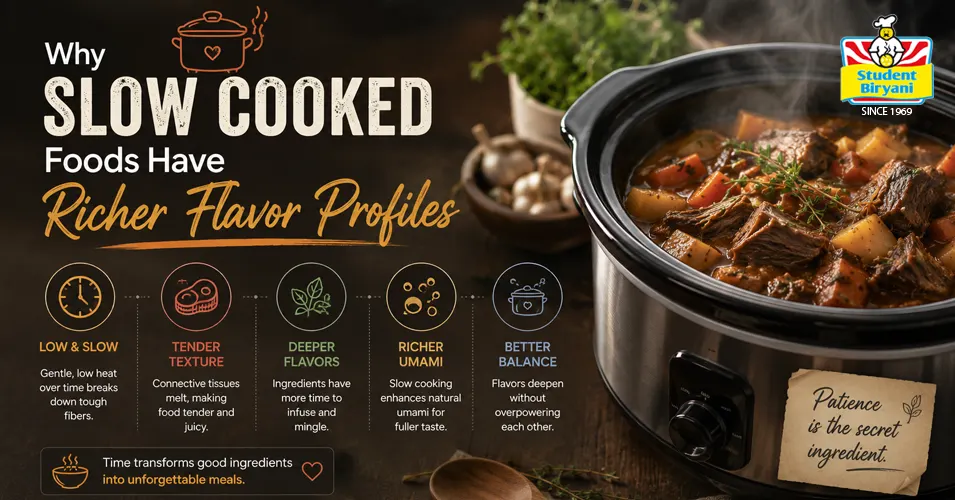
The Assumption Behind Slow Cooking
Most people accept that slow-cooked food tastes better without stopping to ask what time is actually doing. The assumption is reasonable on the surface such as, longer cooking, deeper flavor, roughly proportional. Leave something on low heat long enough and it will taste richer than something cooked quickly.
That assumption is only partly right.
Time is not just duration. Inside a slow-cooked pot, specific physical and chemical processes are running that faster methods cannot trigger regardless of how much heat gets applied afterward. The difference between Nihari cooked overnight and a curry cooked in thirty minutes is not a matter of patience. Something structurally different is happening in the pot, and understanding what that is changes how you read both the dish and the menu it came from.
What Heat and Time Do to Protein
Tougher cuts of meat, such as those commonly used in Nihari and Haleem, contain large amounts of collagen. Collagen is connective tissue. Under normal cooking conditions, it stays tough. Applied heat alone doesn’t fix that. What converts collagen into gelatin is sustained heat held consistently over a long period, and that conversion is what changes everything about the texture of the dish.
Gelatin does something to a sauce that thickened stock or added fat cannot replicate. It gives the liquid body, like a coating quality that sits on the palate rather than running off it. When a bowl of Nihari feels like it has weight and presence beyond its visible ingredients, that’s gelatin at work. The sauce earned that quality over hours of cooking, not through anything added to the pot.
Applying high heat briefly doesn’t accelerate this process. It produces hardened protein instead. The collagen doesn’t convert, but tightens. The meat becomes harder rather than softer, and no amount of additional cooking time at that temperature recovers what was lost in the first few minutes.
Tougher cuts exist specifically for slow cooking. They are not a compromise. They are the correct choice for a method that needs time to work, and they produce results that premium cuts cooked quickly cannot match.
For readers curious about how this plays out in a specific dish, how slow cooking transforms the texture and composition of Haleem gets covered in depth when we examine authentic Haleem ingredients and preparation.
What Slow Heat Does to Spice
Spices behave differently depending on how long they stay under heat, and the difference matters more than most menus suggest.
Many spice compounds are fat-soluble. They release into fat rather than water, and they need time and sustained heat to fully extract. A spice added to a fast-cooked dish releases some of what it carries. The same spice held under slow heat for hours releases more completely, and the compounds that emerge later in that process are often the ones responsible for depth rather than sharpness.
Whole spices behave differently from ground ones under slow heat. Ground spices release quickly and can exhaust their flavor early in the cooking process. Whole spices release gradually, contributing at different points during a long cook and interacting with each other as they do. A clove added at the beginning of an overnight Nihari is doing different work at the two-hour mark than at the eight-hour mark.
That layered release is what separates a sharp spiced dish from a deeply flavored one. Sharpness comes from concentrated surface contact between spice and heat. Depth comes from compounds that extracted slowly, interacted with fat, protein, and each other over time, and settled into the dish rather than sitting on top of it.
This connects directly to how spices behave during dum cooking, where a similar principle of gradual release under contained heat produces the layered aroma that makes biryani smell the way it does.
Fat, Time, and Why the Sauce Tastes Different
Fat in a slow-cooked dish is not doing the same job as fat in a fast-cooked one.
Under sustained low heat, fat renders. It breaks down from its solid or semi-solid state, releases into the liquid around it, and redistributes through the sauce over the course of cooking. As it moves through the pot, it picks up fat-soluble spice compounds and carries them into parts of the sauce that water alone wouldn’t reach. By the end of a long cook, the fat has become a delivery system rather than just an ingredient.
What that produces in the sauce is a coating quality. A slow-cooked curry sauce doesn’t sit in the bowl the way a quickly made sauce does. It has weight behind it. When it coats the back of a spoon or settles across a piece of meat, it brings flavor with it rather than just moisture. That quality is not achievable by adding more fat to a fast-cooked dish. The rendering process is what creates it, and rendering takes time.
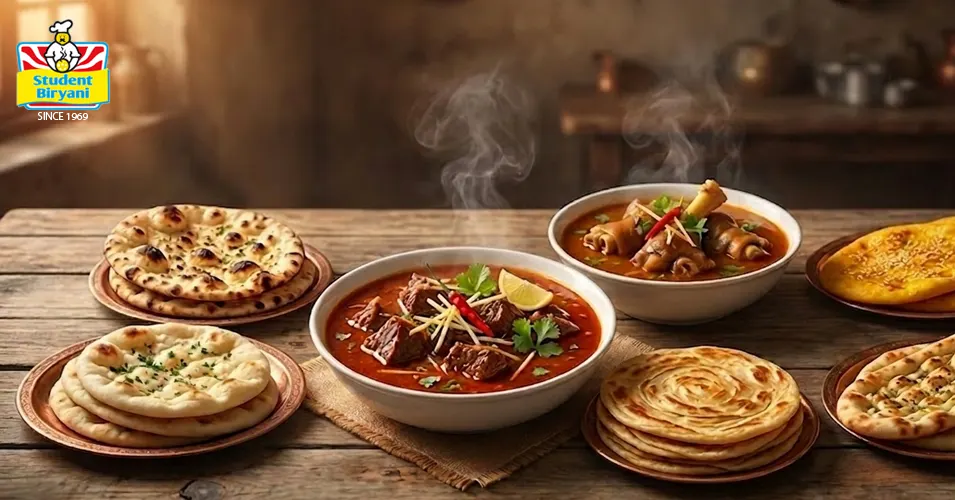
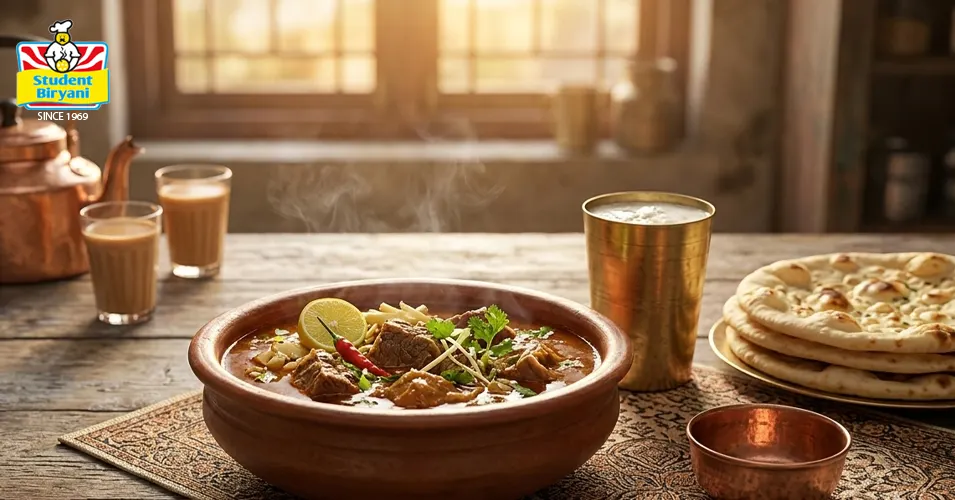
Nihari is the clearest example of this. The sauce in a properly made Nihari has a presence that results directly from hours of fat rendering and redistribution alongside collagen conversion. Both processes running simultaneously over a long cook produce something that neither could produce alone.
This fat behavior connects to how fat behaves as a cooking medium in dishes like korma, though the mechanism differs. Korma uses fat as a base from the start. Slow cooking transforms fat that was already in the meat.
Why These Dishes Cannot Be Rushed
Nihari, Haleem, and Handi are not slow-cooked because of tradition. They are slow-cooked because the qualities that define them only exist on the other side of sustained cooking time.
Nihari without overnight cooking is a spiced beef soup. The gelatin hasn’t developed, the fat hasn’t rendered and redistributed, the spice compounds haven’t had time to settle into the sauce. What gets lost is not flavor in the simple sense. What gets lost is the structural result of a process that was cut short.
Haleem takes this further. Wheat, lentils, and meat are cooked together long enough that the boundary between them breaks down. The final texture, that dense, unified consistency that makes Haleem immediately recognizable, is not achievable any other way. It is what sustained cooking does when three different ingredients spend enough time together under heat. Student Biryani’s Haleem and Nihari are both prepared through the same extended cooking process. If you’d like to experience the result for yourself, order Haleem or Nihari at any UAE branch..
Handi, as discussed in how handi uses sealed heat to develop flavor, produces its depth through a different version of the same principle. Containment over time, rather than open reduction, creates the layered aroma and integrated texture that defines it.
Fast cooking produces food. Slow cooking produces specific things that fast cooking structurally cannot. That distinction is not about tradition or patience. It is about what heat and time do together when they are given enough of both.